
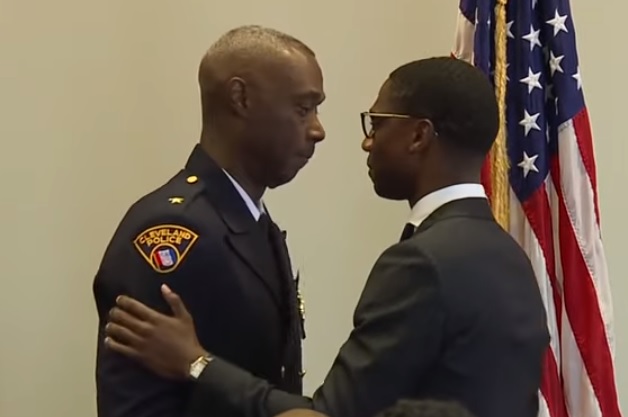

CLEVELAND, OH – In an April 21, 2022 podcast interview with convicted ex-Cleveland Councilman Joseph Cimperman, president of Global Cleveland, the Jamaican immigrant who Mayor Justin Bibb appointed as his interim chief of police in 2022, and safety director in 2024, Dornat A. Drummond, told a revealing immigration story about his mother’s arrival in the United States of America (U.S.) from Jamaica in 1969. Bibb is a “sanctuary city” mayor.
Drummond did not include a description of the visa that granted a mother he calls “Patsy” the authority to enter, work and permanently remain in the United States of America and travel back and forth to Jamaica since 1969. Drummond never told Cimperman he had become a Legal Permanent Resident as a child and that he naturalized as a U.S. citizen by the age of 18. That is what Title 8 and sections 1427 and 1432 of the United States Code required until 2001.
It’s typical of Cimperman and his Global Cleveland non-profit to ignore matters of compliance with regards to U.S. immigration and espionage laws as someone who exhibited criminal tendencies as a convicted former member of Cleveland city council. None of his Sister City relationships have been authorized by the U.S. Department of State. Americans, under the Espionage Act that former FBI Director and Special Counsel Robert Mueller used to prosecute 34 of President Donald Trump’s campaign associates, don’t have carte blanche to initiate communications with officials of foreign governments pursuant to the “Logan Act.” Councils’ expenditure of public funds to support Global Cleveland could make it an FBI target for the unauthorized Sister City relationships he’s convinced them to enter, and the foreign flags he’s been directed as an unregistered foreign agent to ask them to fly over city hall.
For the record, Bibb’s double-dipping retiree he’s kept working past his retirement is not named “Wayne.” It is not a name his $390,000 a year safety director ($195,000 salary and pension combined) asked the Cuyahoga County probate court to grant him permission to change to from “Dornat.” “Wayne” is what Dornat likes to be called. He doesn’t explain to Cimperman how or why he acquired the alias. It could be that “Wayne Drummond” as an alias, sounds more American than “Dornat Drummond.”
I did not know when he was appointed as Cleveland’s police spokesman by former Mayor Jane Campbell, that his name was not Wayne when I covered her administration as the publisher of Cleveland Challenger from 2002 through 2005 and her loss to former Mayor Frank Jackson. I don’t remember any Cleveland cops, then, discussing his Jamaican ancestry.
From my Cleveland police coverage after leaving former Mayor Michael White’s administration as one of his special assistants, Drummond maintained a separation from American Negro Cleveland police forming my opinion of the Campbell administration’s police appointees and operational practices. I have no idea what role he played in the data Cleveland State University Professor Ronnie Dunn’s 2000 report that 85 percent of Cleveland police citations were issued to dark skinned American Negro males. What I know is Drummond’s career shows no evidence of him addressing it.
Dornat is a surname used in the United Kingdom whose kings and queens greatly influenced Jamaica’s culture while under British colonial rule until 1962. The enslavement of Africans ended there in 1838. Drummond might be one of the only “Dornat’s” in greater Cleveland. As a Jamaican, Drummond’s national head of state at his birth was the Queen of England. If his family ever sought reparations for the sacrifices of his enslaved ancestors, they’d have to ask King Charles.
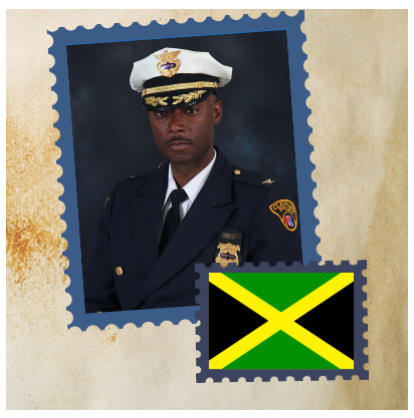
Four years before Drummond’s mother crossed U.S. borders, Congress in 1965 enacted a seven-category immigration admission system that was divided by family and skill-based preferences. Refugees were given the seventh category. Drummond’s mother had to meet at least one of the seven qualifiers if she wanted to lawfully enter the USA. Based on Drummond’s conversation with Cimperman, she didn’t meet any.
Drummond’s mother couldn’t tell U.S. immigration officials she was the unmarried child of a U.S. citizen or permanent resident. She wasn’t. Drummond admits she left him and his brother, Nigel, with their Jamaican grandparents in 1969. He says nothing about his Jamaican father.
Drummond’s mother possessed no special education or skills as an alien looking to escape the “hut” and “outhouse” life he describes being born into as a barefoot, Third World Jamaican villager. She wasn’t an investor with large sums of money. She hadn’t served in our armed forces. She wasn’t seeking political asylum. According to Drummond, she simply traveled to Cleveland for “better opportunities.”
To work, Drummond’s border crossing mother needed an approved H1 visa that wasn’t lawfully available to her. Work visas are supposed to be issued to aliens with special skills Americans don’t have. They don’t advertise our jobs in foreign countries and aliens receiving H1 work visas are supposed to apply for work outside the U.S. The employer applies for the H1 visa.
The former Mount Sinai Hospital was required to first apply and then certify to the U.S. Department of Labor, through the Ohio Department of Labor on federal forms, that qualified Americans in Cleveland, and the rest of the U.S., lacked the skills and did not want to work in its kitchen. This was after they’d advertised the job in the U.S. employment market and Drummond’s mother learned of the job in Jamaica, applied and Mount Sinai’s staff determined she was the only “minimally qualified” applicant. No temporary visa available to her authorized her to apply for work.
All of the records associated with the transactions I’ve described would be in Drummond’s mother’s Alien Registration File if her presence in Cleveland has been lawful. Drummond and his two brothers are supposed to have their own files if she obtained “H4 dependent visas” to relocate her children here.
According to Drummond, his mother’s ability to enter and stay in the U.S. came from a Jamaican cousin, Winton, who already lived in Cleveland when she arrived in 1969. From the way Drummond described his mother’s cousin to Cimperman, Winton was willing to violate Title 8, Section 1324 of the United States Code to harbor her as an illegal alien. If caught he might have faced a one year prison sentence and deportation.
Through her “chain migrating” cousin, Drummond’s mother found a network of homeowners in Shaker Heights, Beachwood and other eastern suburban immigrant populated cities whose property owners hired undocumented aliens as domestics to work as maids, housekeepers and gardeners. A check of the family histories of many Eastern European families in the area, like the Beachwood Ratner’s of Forest City Enterprises, will reveal the descendants of illegal aliens. Drummond told Cimperman he, at first, was ashamed of his mother’s social status as a domestic.
With her cousin’s help, Drummond’s thick accented mother was able to blend in with the 400,000 American Negroes living in Cleveland between 1969 and 1972. She spent three years working, saving and sending money “home.” By 1972 Drummond’s mother, a woman described as decent and hard working by a friendly source, returned to Jamaica for her two sons, and her sister’s son to live in Cleveland. The source said Drummond’s youngest brother, Nigel, is actually a cousin who was raised as his brother.
Drummond says he was born in May 1965 in Montego Bay, Jamaica. Specifically, he told Cimperman he lived in a village near Montego called Great River. It doesn’t exist on a map of Jamaica. What does exist on a Jamaican map is the 47 mile long body of water called Great River that connects to Montego Bay. A search for a list of Jamaican villages, even those with populations of under 750 residents, show no results for the village of Great River. That’s not to say it doesn’t exist as an unincorporated part of Jamaica.
In his interview with Cimperman, Drummond described living in a one room shack with no running water and an out house as part of his early years in Jamaica. Water was collected in a rain barrel. Until his mother returned to get him and his “brothers,” he was raised by his grandparents.
To stay in the U.S. after turning 18, Drummond, his brother and cousin had to apply, individually, for U.S. citizenship by submitting an N-400 application to U.S. Customs & Immigration Services or leave.
The problem is there was no path to U.S. citizenship for Drummond and his “brothers” if their mother was undocumented and working. Drummond would have turned seven years old in 1972 and have no knowledge of the legality of his mother’s immigration to the U.S.
On his form N-400, if he ever completed one to become a U.S. citizen, Drummond had to swear on the citizenship application that his mother was either a naturalized U.S. citizen or a Lawful Permanent Resident with a green card by his 18th birthday in 1983. She had to have continuously resided, legally, in the U.S. for five years. She could not have done so between 1969 and 1972 or afterwards as an undocumented foreign employee of Mount Sinai hospital.
In his interview with Cimperman, Drummond never explains how or if he became a U.S. citizen, or if his mother applied for and received Lawful Permanent Resident status or took the oath of allegiance that would make her an American. He says his mother wanted the boys to “be” good and productive citizens; though the way she entered the U.S. made citizenship for Drummond a statutory impossibility. It’s as if she was encouraging them to “act” like an American so they didn’t get caught. It may explain why Drummond is not registered to vote in Ohio. It’s a privilege reserved for citizens and impersonating a Citizen of the United States is a federal crime that comes with a three-year prison sentence pursuant to 18 U.S.C. 911.
Once in Cleveland, Drummond and his brothers dropped the Patois language and their Jamaican accents, and assimilated to a culture they didn’t know but had to learn. His mother acquired a home on E. 95th Street between Cedar and Quincy Avenues, which he said she still owns. E. 95th Street isn’t a long or well-populated street. A search of county property records don’t reveal any Drummonds as homeowners. Drummond’s mother’s name is different. Foreign property owners are required to register with Ohio’s Secretary of State.
Once the boys became Americanized through the Cleveland Municipal School District, no one questioned Drummond’s national origins or citizenship though he does not conceal where he was born.
As a Jamaican Negro who looked and spoke like an American Negro, Drummond could not legally obtain any state or federal grants to attend either Tennessee State University or the University of Toledo without naturalization documents. Ohio doesn’t authorize in-state tuition for undocumented children of undocumented aliens. Federal laws prevent undocumented aliens from receiving tax supported benefits or professional licenses. Affirmative action and minority set aside laws were not intended for Jamaicans.
If Drummond did not apply for and obtain U.S. citizenship by 18, he and his “brothers” should have paid for their own college educations if they were lawfully present. Without the ability to prove his U.S. citizenship, Drummond should not have been certified as a peace officer by the Ohio Peace Officer Training Academy. His answers on city, state and federal law enforcement documents could be revealing.
Drummond came across to Cimperman as an alien who has never pledged his loyalty to the U.S., and who’s been in management control of a well-armed and militarized major municipal police department for the past four years. Alternative names are not authorized for aliens completing an N-400 application form to apply for U.S. citizenship. They can “change” their names on the N-400, but no nicknames. From a national security perspective, Drummond could be an unidentified and undocumented British subject who is a national security risk. He’s publicly living under an assumed name as a cop that doesn’t lead anyone searching for background information to anything that identifies to him.
Mayor Justin Bibb’s last chief of police and current director of public safety is not a non-voting Jehovah’s Witness as a self-identified Protestant congregant of East Mount Zion Baptist Church. It is illegal to vote in any election as an undocumented alien. It’s hard to think of a city employee who’s never voted for any of his mayor and council employers.
As a Cleveland police officer whose immigration story doesn’t include a published statement that he ever applied for U.S. citizenship, Drummond has had access to the Federal Bureau of Investigation’s (FBI) National Crime Information Center database since 1989. It’s a national security law enforcement tool an undocumented alien should never be given access to see, add or delete information. Immigration & Customs Enforcement (ICE) uses it for deportation purposes, and entering and tracking alien criminal records histories here in the U.S.
The mayor who administered Drummond’s oath of office, the late George V. Voinovich, was born to alien parents from Serbia and Slovenia. The illegal alien community in Cleveland has had plenty of help from elected officials who are supposed to protect the city hall workforce from illegal alien workers and don’t. Cleveland city hall has a growing presence of foreign workers whose authorization to work and citizenship has not been verified.
In 1996 Congress enacted the Illegal Immigration Reform and Immigrant Responsibility Act. It required the Social Security Administration (SSA) and U.S. Citizenship and Immigration Services (USCIS), formerly the Immigration and Naturalization Service, to conduct an electronic employment verification program. E-Verify works by electronically comparing the information from an employee’s Form I 9 with records available to SSA and/or DHS to verify the identity and employment eligibility of each newly hired employee and/or employee assigned to a covered federal contract.
Apart from any state or local law that requires participation in E-Verify, employers are fully responsible for complying with sections 274A (which addresses the requirements of the Form I-9 process) and 274B (which addresses unfair immigration-related employment practices) of the Immigration and Nationality Act. Employers who fail to comply with either section may be subject to penalties.
In his interview with Cimperman, Drummond explained how he’s training police to provide “services” to aliens in the sanctuary city Bibb and Cuyahoga County Executive Chris Ronayne are creating that don’t include law enforcement. Police pursuant to Section 737.11 of the Ohio Revised Code were given federal criminal law enforcement authority, which gives them a duty to arrest and turn undocumented aliens over to ICE.
Instead, Drummond told Cimperman aliens from Jamaica, Ireland, Mexico, India, Japan, Ukraine and other places are interacting with Cleveland police he’s identified as “guardians” to “get them help and the service they need.” Drummond said he wants aliens to feel comfortable in Cleveland. It is only Americans he’s been recruiting, civil service testing and training Cleveland police to arrest, chase to death and kill.


